
In the rapidly evolving landscape of AI deployment, most organizations are currently flying blind, relying on what Engineer Daraima Bassey N. calls “fashionable vagueness” and “shallow talk”. We speak about risk as if we all share a definition, yet the moment implementation begins, the terms become “slippery”. One team means severity, another means probability, and another simply means the system sounds important.
This confusion isn’t just an academic problem; it’s a dangerous governance failure. It is exactly why, after three months of intense frustration when his DyFram project stalled, Engineer Daraima realized that the world didn’t need another checklist it needed a measurement grammar.
This post serves as a formal proposal for the adoption of Govlanes Risk Engineering, a disciplined architecture designed to turn risk from a “mood or metaphor” into a countable, actionable quantity.
1. The Language Problem: Why Your Current Risk Talk is Failing
Modern AI governance often inherits an old weakness: we treat risk as a “floating label”. We group a simple grammar assistant in the same “AI” category as a welfare triage system or a hiring screener, even though the stakes are worlds apart.
If your organization cannot distinguish between a “reversible inconvenience” and “durable exclusion” from a life path, your governance is theatrical, not substantive. Govlanes Risk Engineering replaces this rhetoric with an interpretable structure that allows engineers, board members, and regulators to finally speak the same language.
2. Introducing Degrees Exposure (°exp): Making Risk Countable
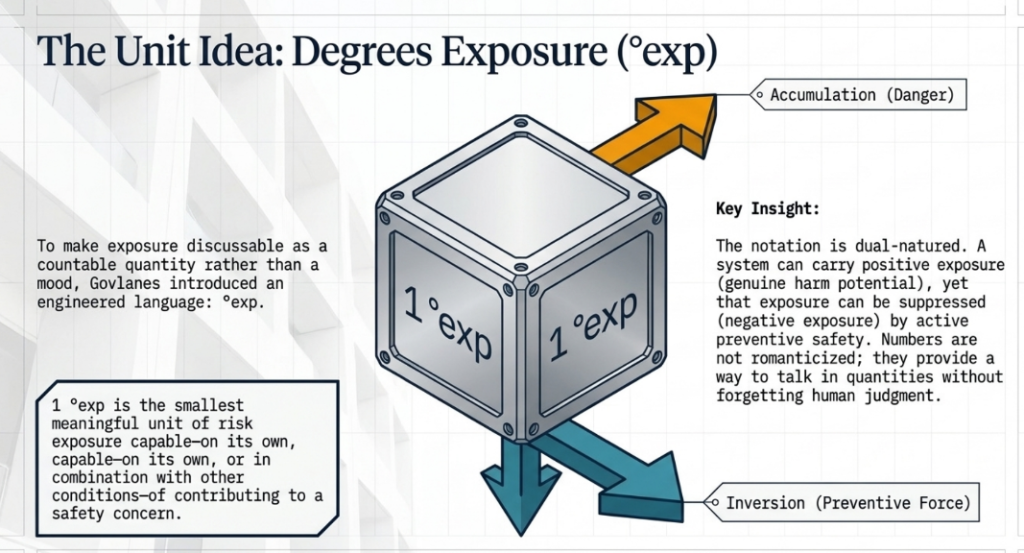
The core innovation of the Govlanes “intellectual novel” is the unit idea: Degrees exposure (°exp).
Engineer Daraima proposed 1 °exp as the smallest meaningful unit of risk exposure capable of contributing to a safety concern. By treating exposure as a quantity, we move away from “opaque mysticism” and toward repeatable interpretation.
- Positive Exposure: Represents the genuine harm potential a system carries.
- Negative Exposure: Represents real Preventive Safety (PS) actual suppressive force rather than mere optimism.
This unit allows a governance team to move beyond saying “the system is risky” to saying exactly how much exposure is live.
3. The Architecture of PH and PS: Preserving the Discipline
The Govlanes model is built on two companion ideas: Potential Harm (PH) and Preventive Safety (PS).
Potential Harm (PH)
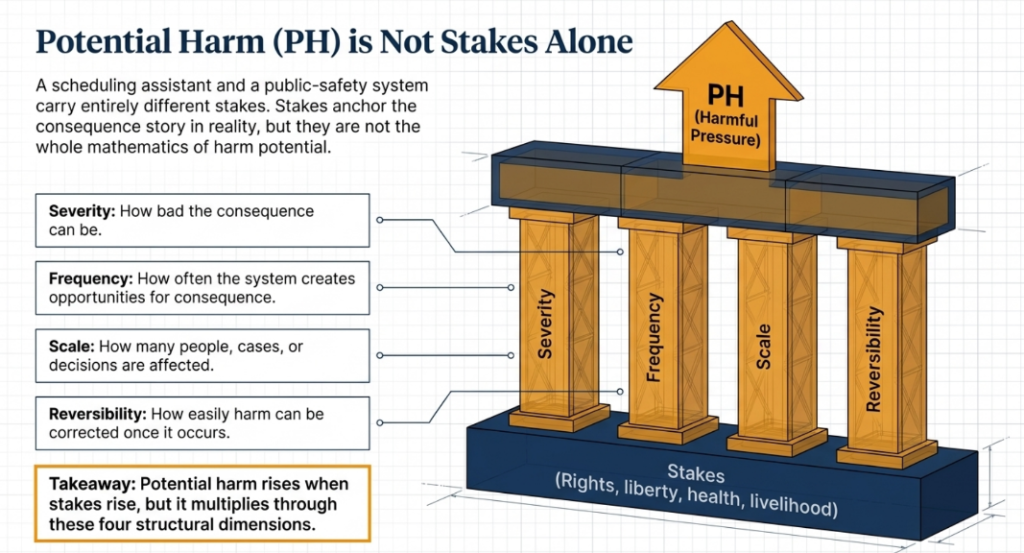
PH answers the question: What harm potential lives inside this deployment if the relevant conditions become active?. It is more than just “stakes”; it is a calculation of the “live harmful pressure” generated by five distinct dimensions:
- Stakes: What is truly on the line (rights, health, livelihood, trust).
- Severity: How bad the consequence is when harm materializes.
- Frequency: How often the system creates opportunities for consequence.
- Scale: How many people, cases, or decisions are affected.
- Reversibility: How easily the harm can be corrected.
Preventive Safety (PS)
PS is not “ceremonial compliance” or “public relations”. It is treated as a live suppressive force the genuine capacity of controls (like human-in-the-loop oversight, traceability, or operational gating) to catch, slow, or soften harm before it matures.
4. The “Gift” of Gross vs. Net Exposure
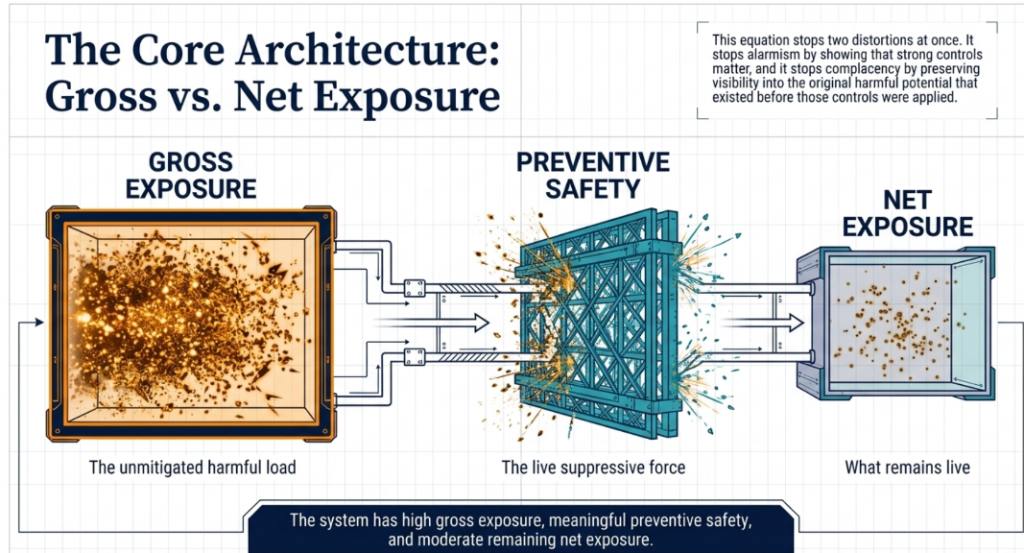
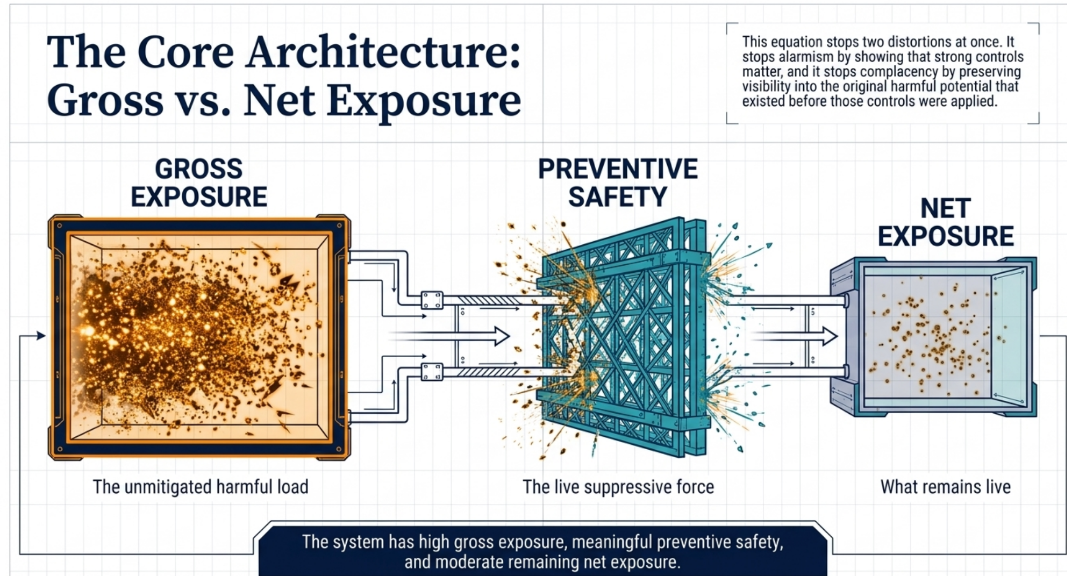
The gross-versus-net distinction is one of the clearest advantages of this framework.
- Gross Exposure: What the system carries before safety suppression is counted.
- Net Exposure: What remains live after those protections are considered.
This prevents two common organizational failures:
- It stops alarmism: By showing that strong controls actually matter.
- It stops complacency: By preserving visibility into the original harmful potential that existed before the controls were applied.
As Engineer Daraima notes, a team can finally say: “The system has high gross exposure, meaningful preventive safety, and moderate remaining net exposure”. This is a far more mature and useful sentence than “the safeguards solved it”.
5. From Theory to Engine: The DyFram Reality
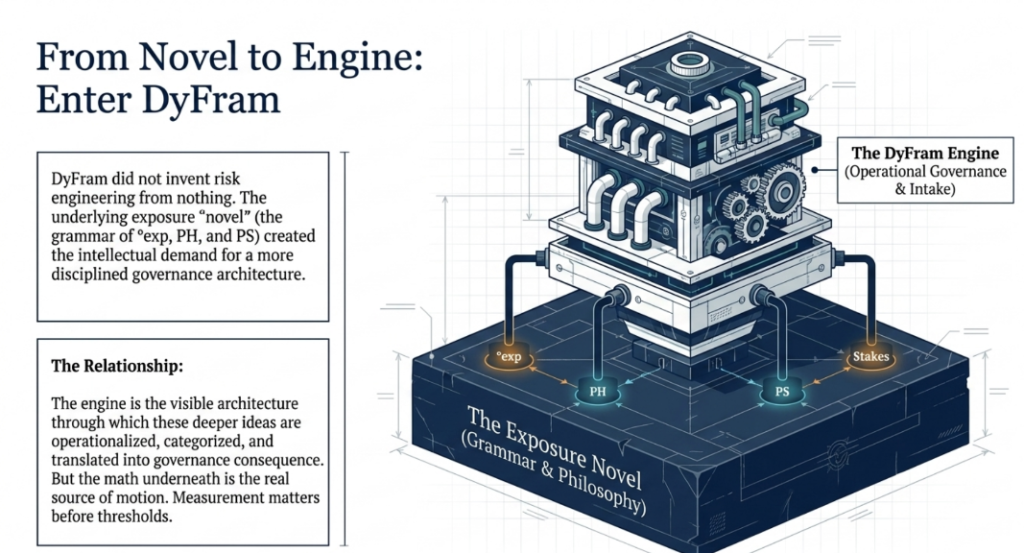
While the philosophy is deep, the application is practical. This “novel” of exposure created the intellectual demand for DyFram, the multi-dimensional governance intake engine.
DyFram is not a random score generator or a flat checklist. It is a stable system that takes in structured questions about a use case’s risk signature and translates them into governance consequences through version-aware discipline. It ensures that if a system’s capability risk remains high, your net score only drops if your Preventive Safety is a “real force” not a decorative one.
Conclusion: Why Adopt Now?
The Govlanes Risk Engineering architecture is a point of view that insists language matters before regulation. It is a call for institutions to stop settling for “fashionable vagueness” and demand a “better grammar for one of the hardest governance problems of this era”.
If risk is real, it should be speakable. If prevention is real, it should be countable. We invite you to move beyond intuition and start measuring your systems in Degrees exposure (°exp).
Test the future of risk engineering. Adopt the Govlanes framework.